¶ Battery & Charging
¶ What do the battery indicator lights mean?
A: The battery indicator light shows both charging status and remaining battery when the charger is plugged into the battery. A red light means the battery is not charging, while a solid white light indicates it is fully charged. When blinking, the white light shows the battery level: 1 blink for 0–25%, 2 blinks for 26–50%, 3 blinks for 51–75%, and 4 blinks for 76–99%.
¶ What is the weight of the battery?
A: Long-range Battery weight: 13.23±1.10 lbs / 6±0.5 kg
Flight-safe Battery weight: 9.5±0.4 lbs / 4.31±0.2 kg
¶ What are the battery dimensions?
A: Dimensions: 8 * 4.3 * 12.2 inches / 204 * 108 * 310 mm
¶ What is the expected range and standby time for the Flight-safe Battery?
A: The Flight-safe Battery range may vary depending on terrain, speed, driving habits, user weight, load, temperature, and battery condition.
Based on actual road testing with a 91 kg (200.6 lb) load on urban roads, the estimated range is:
Range Mode: approximately 11.6 miles / 18.6 km (standby time of approximately 17 to 25 hours)
evSense Modes: approximately 9 miles / 14.5 km (standby time of approximately 7 to 8 hours)
To extend battery life, use Range Mode when appropriate and turn off Strutt vehicle if it will be idle for a longer period.
¶ What were the test conditions for the 20 mile (32 km) claim?
A: The 20 mile (32 km) range was achieved under controlled test conditions: a fully charged vehicle carrying a 91 kg (200.6 lb) load, at an ambient temperature of 20°C (68°F), with Range Mode enabled (evSense disabled). The vehicle was driven at a constant 4 mph (6.4 km/h) on a smooth, flat, hard surface until the battery was depleted.
Actual range will vary based on rider weight, terrain, temperature, and riding habits.
¶ How much battery power does the vehicle consume in different operating modes and power states?
A: The image below includes the power consumption for all conditions, including powered on while stationary, Sleep Mode, Range Mode, Sleep Mode in Range Mode, and powered off.
The evSense modes refers to Manual, Co-pilot, and Co-pilot+ modes.
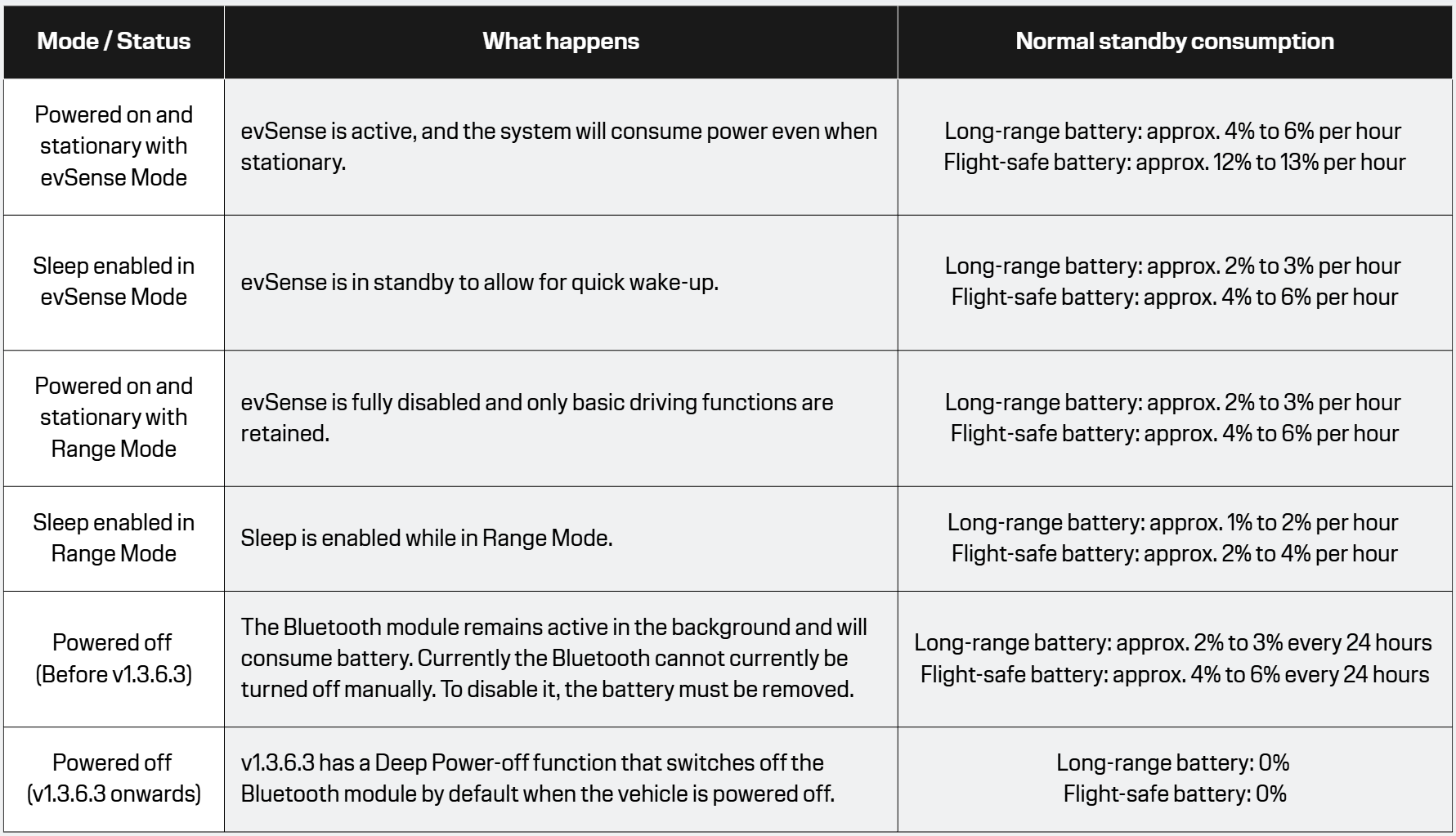
Please note that the Deep Power Off disables Bluetooth by default, after the vehicle enters Deep Power Off you cannot power on the vehicle through the Strutt App. You can change this setting in Settings > General > Power Management > Deep Power-off Time. For the period of time selected, you will be able to power on your vehicle from the Strutt App. Do note that, it would also experience a power consumption of about 2 - 3% every 24 hours.
¶ What is the best practice for battery charging?
A: The battery can be charged at any time using any of the three supported charging methods. Refer to the Best Practices for Battery Charging for detailed instructions.
After each software update, please charge the battery to 100%. This helps recalibrate the battery level reading and reduces the likelihood of an unexpected loss of power during use.
Note: The battery and charger may become noticeably warm during fast charging. This is normal. Keep them uncovered and well ventilated to allow heat to dissipate. The battery and charger include built in overcharge protection.
¶ What are the recommended battery storage conditions?
A: The optimal storage temperature for the battery is 0 to 25°C (32 to 77°F), and the optimal storage charge level is 30 to 50%.
¶ What affects the vehicle battery drain, and how can I make the battery last longer?
A: The maximum driving range of Strutt vehicle is measured under specific ideal test conditions. Actual range may vary depending on factors such as terrain, speed, driving habits, user weight, load, ambient temperature, and battery condition.
As a guide, the tested range is:
- Range Mode: up to 20 miles / 32 km
- evSense Modes: up to 16.2 miles / 26 km
The driving range is tested by running the vehicle at a constant speed until the battery is depleted. In everyday use, frequent stop-and-go movement, higher speeds, slopes, rough surfaces, or heavier loads may cause the battery to drain faster.
The vehicle also consumes power while stationary because its systems remain active. To conserve battery:
- Use Range Mode when appropriate. It disables evSense and its related functions, so use it only in suitable environments.
- Avoid sudden acceleration and braking.
- Use Sleep Mode during short breaks.
- Power off the vehicle during longer periods of inactivity.
¶ What type of battery does the vehicle use, and how far can it travel on a full charge?
A: Both the Long-range Battery and the Flight-safe Battery use lithium iron phosphate (LFP) battery chemistry.
The estimated driving ranges are:
| Battery | Range Mode on | Range Mode off |
|---|---|---|
| Long-range Battery (640 Wh) | Up to 20 miles (32 km) | Up to 16.2 miles (26 km) |
| Flight-safe Battery (288 Wh) | Up to 11.6 miles (18.6 km) | Up to 9 miles (14.5 km) |
*Actual driving range, obstacle clearance, and overall performance depend on several factors, including the product configuration, battery age and condition, driving behavior, total payload, terrain, and environmental conditions. Test results are provided for reference and may not represent performance under all real world conditions.
¶ What is the expected lifespan of the battery?
A: The Long-range Battery is rated for a typical lifespan of approximately 3,200 full charging cycles.
¶ Can the battery be overcharged?
A: Strutt batteries and chargers include built in charging protection. Charging stops automatically when the battery is fully charged to prevent overcharging.
Important
Use only an officially compatible charger. Third party chargers may present safety risks or damage the battery.
¶ How can I protect the battery and extend its service life?
A:
- Avoid fully discharging the battery. Whenever possible, recharge the battery when its remaining charge reaches approximately 20% to 30%.
- Avoid extreme temperatures. Do not charge or operate the vehicle in very hot or cold conditions. Avoid prolonged exposure to direct sunlight.
- Recharge the battery during long term storage. If the vehicle will not be used for an extended period, recharge the battery every one to two months. This helps prevent self discharge from reducing the voltage to a level at which the battery cannot be activated.
- Use an approved charger. Always use the supplied charger or another charger officially approved by Strutt.
¶ Does the Strutt Flight-safe Battery support driving with Level S?
A: No. The Flight-safe Battery does not support Level S because its smaller capacity cannot provide the required high power output.
¶ Why does the Strutt vehicle show “Battery connection lost”?
A: This message is triggered when battery communication is interrupted, usually because of a physical connection issue. For more details on how to handle this issue please see Troubleshooting: "Battery Connection Lost".
¶ Why is my battery taking longer than usual to charge or why does the displayed battery level seem inaccurate?
A: These issues may occur when the battery is performing a calibration process. During calibration, the battery analyzes its charging and discharging behavior and updates its capacity estimate. This helps improve the accuracy of the displayed battery level.
The displayed level may gradually become less accurate if the battery is rarely charged until the indicator shows a solid white light or if the vehicle frequently remains powered on while charging.
Charging also slows when the battery level reaches approximately 90% to safely complete the final stage. In some cases, a more thorough calibration may be required, which can take longer than a normal charging cycle.
To help maintain an accurate battery level reading:
- Power off the vehicle before charging whenever possible.
- Allow the battery to continue charging until the indicator shows a solid white light.
- Avoid regularly interrupting the charging process before the battery is fully charged.
When the indicator shows a solid white light, the battery is fully charged and ready for use.
¶ Why does the charger indicator differ from the battery level shown on the vehicle?
A: When the battery is charged separately from the vehicle, the charger indicator provides only an approximate indication of the charging progress. It does not show the exact battery level.
For the most accurate reading, install the battery and check the battery level on the vehicle’s display.
¶ How long does the battery take to charge?
A: Approximate charging times are shown below:
| Battery type | 0%–80% | 0%–100% |
|---|---|---|
| Long-range Battery | Approx. 2 hours | Approx. 4 hours |
| Flight-safe Battery | Approx. 1.2 hours | Approx. 1.8 hours |
Actual charging times may vary depending on the battery temperature, condition, and whether the vehicle remains powered on while charging.
¶ What temperature range is recommended for charging the battery?
A: The optimal charging temperature for the battery is 20–25°C (68–77°F). The battery can be charged at temperatures between 2°C and 45°C (36°F and 113°F). Charging is disabled outside this range. When the battery is very cold or hot, its power management system automatically adjusts the charging power to protect it. As a result, charging may take longer than usual.
¶ How does temperature affect vehicle performance and driving range?
A: The vehicle automatically adjusts its performance based on the battery’s current temperature and condition.
- High temperatures: Driving range is generally less affected, but power output may be reduced. When the battery temperature exceeds 40°C (104°F), the vehicle may limit its power and speed to help prevent overheating.
- Low temperatures: Both power output and driving range may decrease. Cold temperatures slow the chemical reactions inside the battery, reducing the amount of energy it can provide. This effect may become more noticeable as the temperature decreases.
¶ Can I charge the battery while the vehicle is powered on?
A: Yes. However, charging will take longer because the vehicle continues to consume power.
After the battery reaches a full charge, the displayed level may temporarily fall below 100%, or charging may restart to top up the battery. This is normal and occurs because the vehicle continues to use power while it remains switched on.
For faster and more consistent charging, power off the vehicle before charging whenever possible.